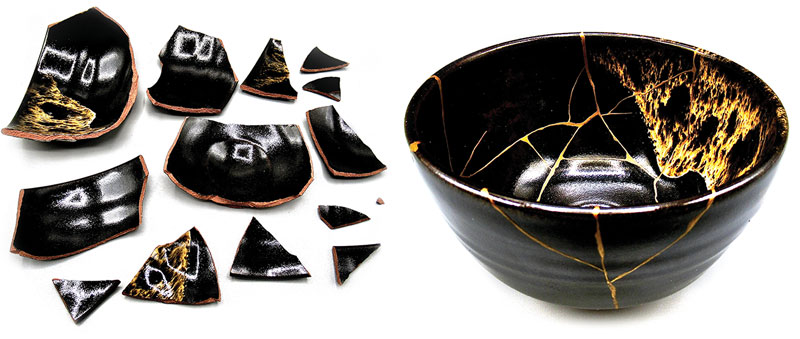
Photo credit: (Japan Daily, 2025)
This year, discussions about what is and isn’t “natural” in humanity have intensified; often directed at the LGBTQ+ community and transgender people in particular. But many disabilities have been getting the short end of the stick as well. With anti-vax protests, abortion rights debates, threats to same-sex marriage rights, and now the ADA coming under fire, it’s hard to turn a blind eye. Of course, I would be the last person to advocate for ignoring the problem, which is exactly why I believe a Wabi-Sabi view on life can help us now.
Wabi-Sabi is a Japanese cultural philosophy centered on the beauty of imperfection, impermanence, and simplicity. The name comes from two Japanese words: wabi, a humble appreciation of authentic simplicity, and sabi, the beauty that often comes with aging and wear. Together, the Wabi-Sabi philosophy places a high value on acceptance, humility, and the natural rhythms of life. In other words, true beauty is found in life’s imperfections (Wantanabe, 2025).
The philosophy and many of its practices are deeply rooted in Zen Buddhism and the medieval Japanese tea ceremony, likely emerging during the 14th to 16th centuries. Some sources attribute its emergence specifically to tea master Sen no Rikyu, who favored rustic pottery and natural materials over the ornate designs popular at the time. This is likely where the practice of Kintsugi comes in, a practice in which broken pottery is repaired with a gold lacquer to highlight the cracks and celebrate the imperfections, rather than being restored to its original state (Wantanabe, 2025; Eichinger, 2024).
Other Wabi-Sabi practices include boro, a type of indigo-dyed patchwork that embraces the repaired reuse of fabric, and sashiko, a visible mending practice with unique tools and stitching patterns. Broadly speaking, Wabi-Sabi teaches us to “take time to notice the subtle moments” in daily life. We can do this by choosing handmade items where possible and repairing old clothes rather than replacing them, and recognizing that each tear or crack has a story behind it (Wantanabe, 2025; James, 2020). For this reason, I also feel that tattoos can be a form of Wabi-Sabi, especially when they incorporate existing scars.
Many of these practices started with working-class families as practical daily necessities before they were embraced and appreciated by the wealthy. Sashiko was used to embellish and repair clothing that couldn’t be replaced. Similarly, boro extended the life of existing clothing using scraps of fabric, seen as shameful by the upper classes precisely because of its necessity. Today, these practices are recognized for their appreciation of imperfection and environmentally friendly approach to daily life (James, 2020).
Kintsugi has even been used as a metaphor for healed wounds. Buddhism teaches three main principles of existence: anicca (impermanence), dukkha (suffering), and anatta (absence of self), summarized in Japanese Zen Buddhism as “all beings in their natural state.” Wabi-Sabi builds on this with its seven aesthetic principles: kanso (simplicity), datsuzoku (freeness), seijaku (tranquility), ygen (subtle grace), fukinsei (asymmetry or irregularity), shibumi (beauty of the understated), and shizen (naturalness without pretension). But at its heart is authenticity, displaying and celebrating flaws rather than avoiding them (Nash, 2021).
Nash (2021) also suggests several practical ways to embrace a Wabi-Sabi lifestyle. Some of their suggestions are definitely a challenge for me, such as embracing minimalism and slow, mindful eating. Others, such as focusing on natural products rather than synthetics and appreciating the signs of aging in all things, have become much easier over time. I also practice Kintsugi as a metaphor in therapy, using trauma and negative situations as a source of growth while seeing the scars as evidence of resilience. Some suffering is inevitable, but with the right support, we can all learn to honor the process and find our own golden lacquer (Nash, 2021).
Another helpful practice in our modern world is Shinrin-yoku, or forest bathing. Research has shown that spending time in nature can help improve blood pressure, autonomic and immune function, and overall mental health. PositivePsychology.com even offers a free downloadable ebook that provides five exercises for embracing imperfections in the spirit of Wabi-Sabi (Nash, 2021). As the philosophy reminds us, a disability is only a disability when it’s compared to other ways of being.
Disability should not be seen as a flaw or imperfection to avoid. It is a natural part of human experience that can begin at any time and evolve throughout life. Disabled people navigate natural and man-made obstacles every day: everyday objects and different types of terrain can affect mobility devices in different ways, visual signals affect how blind people interact with the sighted world, and audible signals do the same for deaf and hard-of-hearing people. And yet, “by embracing imperfection, you cultivate gratitude and peace in a world that often demands perfection” (Wantanabe, 2025; Moonan, 2023).
For neurodiverse people like myself, a sense of predictability and routine can be essential to feeling safe, and nature is often more predictable than people are. Although nature is inherently imperfect, its imperfections are often easier to make sense of and can feel less threatening for neurodiverse individuals. This concept creates its own ironic sense of Wabi-Sabi that simultaneously asks us to acknowledge similarities and appreciate differences. The relative uniformity of a forest can be enchanting. Yet, each tree is different from the next, keeping things interesting; if they were the same, there would be no need to keep looking (Eichinger, 2024).
References
Eichinger, B. (2024). Wabi-Sabi and Neurodivergence. LinkedIn. https://www.linkedin.com/pulse/wabi-sabi-neurodivergence-bob-eichinger-olbic/
James (2020). A Primer on Wabi-Sabi — The Japanese Love of Decay. Heddels. https://www.heddels.com/2020/01/a-primer-on-wabi-sabi-the-japanese-love-of-decay/
Japan Daily (2025). Kintsugi: The Art of Embracing Brokenness and Finding Beauty. Japan Daily. https://japandaily.jp/kintsugi-the-art-of-embracing-brokenness/
Moonan, J. (2023). Tea Class Recap: Wabi Sabi Through the Lens of Disability. The Cultured Cup. https://www.theculturedcup.com/blogs/blogs/tea-class-recap-wabi-sabi-through-the-lens-of-disability
Nash, J. (2021). The Wabi Sabi Lifestyle: How to Accept Imperfection in Life. PositivePsychology.com. https://positivepsychology.com/wabi-sabi-lifestyle/
Wantanabe, A. (2025). Wabi Sabi: Meaning, History, and Traditions. Joyn Tokyo. https://joyn.tokyo/life-guide/culture/wabi-sabi-meaning
 Unicorn Roots
Questions, comments, suggestions? Drop them here.