• Silver Linings — Mobility & Transportation, Part 2

    Waymo Ojai

    In August, I wrote about some of the challenges of getting around with a disability and some accommodations that can help. Waymo’s standard self-driving cars solve most of these problems, and their wheelchair-accessible vehicle (WAV) service covers the challenges of traveling with a wheelchair. Now Waymo riders have a new, larger option: the Ojai robotaxi.

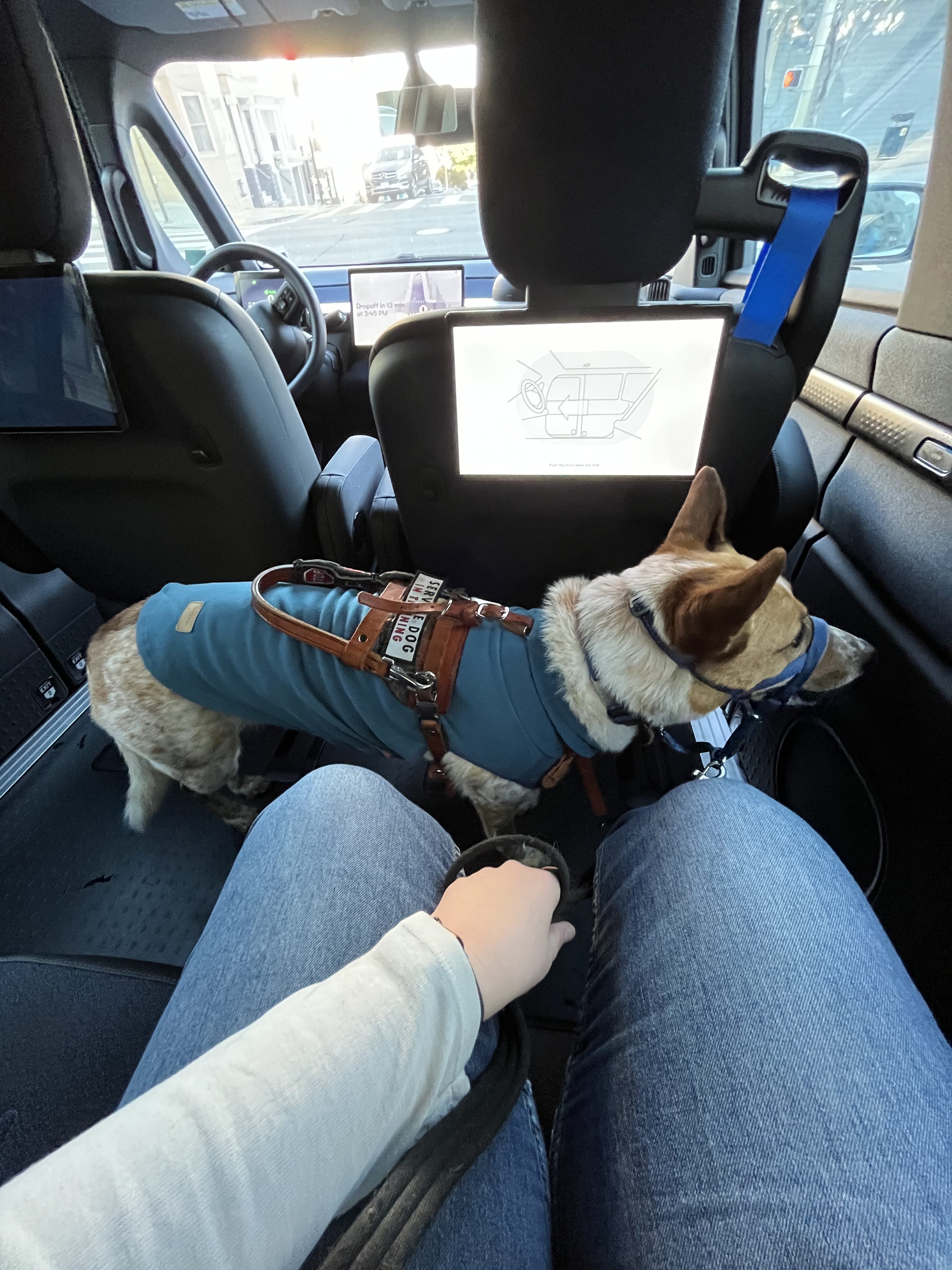
    When I first got an email introducing the Waymo Ojai, I jumped at the chance to test it out. I couldn’t wait. Then, about a week ago, I had an appointment and called a Waymo. I was giddy. I could hear my inner child screaming, “It’s big and blue and special!” Then I realized that, in my excitement, I’d forgotten my service dog’s floor towel. Not to worry. This was definitely worth a potential cleaning fee, and I made a note in my calendar to remember it next time.

    I quietly squealed with joy as the luxurious, baby blue, futuristic robotaxi pulled up in front of me. I stepped in and pulled Frankie in after me. She looked up at me, then started looking for a place to settle. I buckled in, tapped the screen to start the ride, and began looking around to see all the special features.

    The first thing I noticed was the safety features, which the digital flight attendant explained. There were discreet emergency door pulls and two screens in the back showing me everything I needed to know. Then there were the impressive accessibility features: braille above every button, brightly contrasting seatbelts, and enough floor space for multiple service dogs to lounge, or even a wheelchair. The doors also opened very wide with the touch of a button. Unfortunately, there was no wheelchair ramp, but a quick search online told me that Waymo does offer a wheelchair-accessible vehicle (WAV) service. All in all, this was a very accessible Waymo experience. And I look forward to reviewing a nice packable, quick-dry towel to prevent any further drool spots.

    Resources

    Waymo LLC (2025). Wheelchair-Accessible Vehicles. Waymo Help. https://support.google.com/waymo/answer/10656347?hl=en

    Waymo LLC (2026). Our Mission: Be The World’s Most Trusted Driver. Waymo. https://waymo.com/about/

  • Silver Linings –– Assistive Technology, Part 4

    Dyslexie Font

    I can remember having reading problems for as long as I can remember written language. When I was young, I constantly wondered how other kids my age had already finished their reading assignments while I was still trying to understand the title. In high school, I was always the last person to finish writing assignments and tests. I knew I had dyslexia, but the term was never officially used to help me overcome my challenges. Instead, I was told that I was simply a slow reader with a learning disability. All technically true, but this missed the problem with the precise circular logic only school officials and politicians seem capable of.

    I graduated from “special ed” middle school with a level of intelligent snark that still makes my mom proud, quoting Albert Einstein as I accepted my participation award. This brilliant neuro-spicy German scientist once said: “The only thing that interferes with my learning is my education.” Thank you, Dr. Einstein. Your wise snark helped more than you know.

    After toughing it out at my local public high school, I graduated with an expired Individualized Education Plan (IEP), a 4.0 GPA, and a sense of fearful freedom that eventually led me through a few semesters at community college and on to The American College of Healthcare Sciences (ACHS). There I began to look for real-world resources to help myself and others like me navigate a neurotypical world. One of these resources was the then-new Dyslexie font.

    Created in 2008 by Dutch graphic designer Christian Boer, the Dyslexie font was widely available within a decade. I’ve been using the font wherever I could since I discovered it in 2010 during my first year at ACHS. For me, this started on my Kindle Reader and then on my iPad through the Kindle app. Now I use it to read digital books, edit my blog, and get through long research sessions much more efficiently. Thanks, Mr. Boer!

    It seems simple, but the differences can be amazing, especially when resources like Boer’s Dyslexie font are paired with readily available screen readers. It can also be very helpful to show dyslexic children and adults that they’re not alone. Many celebrities and highly successful people have shared these struggles with reading and writing, and are extremely successful despite them. Great authors like F. Scott Fitzgerald and Agatha Christie, actors like Whoopi Goldberg and Chaz Bono (and his fabulous mother Cher), and other greats like George Lucas and Jamie Oliver all triumphed in the face of this invisible disability. There are ways to read and write with dyslexia, and a simple font change like using Dyslexie can help get there.

    Check out the Dyslexie font (with a lifetime license of $69) and its free alternative, OpenDyslexic, at the links in my resources below.

    Resources 

    Dyslexie Font B.V. (2024). What We Did What We Do. Dyslexiefont.com. https://dyslexiefont.com/en/about/

    Neuro Diversity Matters (2022). 83 Famous People with Dyslexia You Would Least Expect. Neuro Diversity Matters. https://neurodiversitymatters.com/dyslexia-famous-people-with-dyslexia/

    OpenDyslexic (n.d.). Open Dyslexic: A Typeface for Dyslexia. OpenDyslexic.org. https://opendyslexic.org/

  • Speechify

    Most people know the term dyslexia, even if they find it ironic that it isn’t spelled phonetically. Most also know that it refers to people who have a uniquely hard time reading and writing. Well, I’m one of those people. One of the approximately 40 million US adults who struggle to read and write. That’s right, I’m a blogger who has a hard time reading and writing about the research that I use in my own articles. But I’m far from alone. Approximately one in ten people have dyslexia. Yet, only around 5% of these 40 million US adults actually have a proper diagnosis. For the rest of us, free assistive technology has to fill in wherever possible. This is where things like auto-correct, audiobooks, screen readers, and the Speechify app make life bearable (Zauderer, 2026).

    For context, of the more than 40 million US adults with dyslexia, around 2 million have a formal diagnosis. Approximately 20% of students have a learning disability that concerns language processing, and the most common learning disability is dyslexia. Some statistics state that diagnoses skew heavily towards men and boys. While this is true, it most likely reflects evaluation processes that have historically favored men and boys. Other statistics have shown that women and girls are equally affected by dyslexia (Zauderer, 2026).

    The broader picture is even more damning. Around 5% of US adults are functionally illiterate and roughly 25% read below a 6th-grade level. More than 80% of people with dyslexia struggle with organization, planning, punctuality, and focus. Around 80% of people in general falsely assume dyslexia is a cognitive disability or connected to one, likely because of its strong correlation with other neurodiversities. For example, 30% of dyslexic kids also have ADHD, and it has been shown to run in families. However, more than 20% of people with dyslexia work in computer science, arts, economics, mathematics, mechanics, and sports (Zauderer, 2026).

    But let’s not stop there. More than 50% of NASA employees are dyslexic. Albert Einstein was dyslexic. With proper accommodations, successful learning is almost guaranteed. Dyslexia simply affects how words are interpreted and processed phonologically, affecting how a person reads, speaks, spells, and learns new languages. These processing differences may explain why people with dyslexia tend to be more creative thinkers, which may also explain why so many of us gravitate to the arts. Celebrity examples include people like Richard Branson, Steven Spielberg, Whoopi Goldberg, Cher, Anderson Cooper, Tom Holland, Keira Knightley, and Orlando Bloom. One quick search will tell you all about Jamie Oliver and his success in the face of crippling dyslexia struggles (Boschen, 2024; Zauderer, 2026).

    All of these statistics speak to why I reviewed Speechify. I could go on for ages about the adaptations and accessibility that have helped me throughout my life, but I’ll try to focus on Speechify here. When I first heard about the app, I was almost in tears. An app that scans your book page by page and reads it to you, highlighting each word as it goes. I wished I’d had this when I was fighting through “simple” school books as a pre-teen and teen.

    I tried the free version in college and again recently, and it definitely sped up my reading. There were a dozen voices to choose from, and I loved it. My free six-month trial period started immediately via email. I uploaded a few books and marveled at the sense of ease it gave me. Then I hit the paywall. 

    What was left on the free plan was a robotic voice with significantly lower quality than the free screen reader included on my phone and computer. My other options were also limited. I could buy a book through their store. I could scan some of the barcodes on other books. Or I could scan in books, page by page. By the time I’d done that, I was ready to buy the audiobook and return the print copy, or give in and pay the $139 for the premium membership. Honestly, I wish I could give this a better review. If the paywall were a little easier to climb, I’d be campaigning for the company myself. But for now, I recommend buying and borrowing ebooks and audiobooks through other means. The concept is great, and I hope that in the future I can come back and write Speechify a glowing review (Speechify Inc, 2026).

    Resources: 

    Boschen, J. (2024). Famous People with Dyslexia: A List for Students and Teachers. What I Have Learned. https://whatihavelearnedteaching.com/famous-people-with-dyslexia/

    Speechify Inc. (2026). About. Speechify. https://speechify.com/about/

    Zauderer, S. (2026). 33 Dyslexia Statistics & Facts: How Many People Have Dyslexia. Cross River Therapy. https://www.crossrivertherapy.com/research/dyslexia-statistics