• Sexuality, Gender Identity, and Disability, Part 3

    Society & Gender

    In Western society, disability tends to be de-gendered, creating an environment that’s generally androcentric — neither gender neutral nor genuinely gender-inclusive. According to 2019 CDC data, 25.4% of men and 28.1% of women in the US identified as or were diagnosed as disabled. The US Transgender Survey also found that 39% of transgender participants had at least one disability, compared to 15% of the general population. But to fully understand the connections between these identities, it’s important to consider how societal gender roles affect, and are affected by, the experience of disability (Slayter & Johnson, 2023).

    Society tells us how women and men are supposed to look and behave. However, these complicated societal rules of gender expression and sexuality become even more complicated by the daily requirements of disability. Femininity isn’t the only personality trait that’s affected by these requirements; masculinity is as well. While masculinity is culturally associated with strength and dominance, disability is often associated with weakness, submission, and inability (Slayter & Johnson, 2023). These cultural assumptions simultaneously demean masculinity, femininity, and the entire disability community.

    To properly understand how these assumptions affect physical, psychosocial, and political outcomes, it’s important to consider how coexisting minority identities add to the harm already caused by the stigma of disability. Stereotypes like the “angry black woman” and the “sissy gay boy” are good examples.  They are clear markers of difference that reinforce othering and contribute directly to harmful social constructs (Slayter & Johnson, 2023).

    A 2017 UK survey actually backed this up with concrete data. The survey showed that 34% of disabled LGBTQ+ adults had experienced inappropriate curiosity from staff, 20% had experienced unequal treatment, 15% had been outted in front of others without their consent, 8% had been pressured to change or suppress their LGBTQ+ identity, and 33% had seen a lack of understanding of LGBTQ+ health needs. Disabled transgender adults were also significantly more likely to have faced discrimination when accessing mental health centers, rape crisis centers, domestic violence shelters, and drug treatment programs. This discrimination was the most pronounced among those with learning disabilities, multiple disabilities, and those with Latino heritage (Green et al., 2023).

    Dating also adds another layer of complexity. Disabled LGBTQ+ women are significantly more likely to have a transgender partner and more likely to be single than their able-bodyminded counterparts. Research has shown that transgender people are around 1.7 times more likely to have experienced domestic violence than cisgender people, and in the US, 61% of disabled transgender adults have experienced some form of financial, physical, or emotional abuse. The wide range of disabilities and LGBTQ+ identities has limited the scope of data, however. So more studies are definitely needed on this subject. That said, many LGBTQ+ people with disabilities can benefit from dating within the community, as a sense of understanding and belonging is already present (Green et al., 2023).

    References

    Green, A.K., Gomes, R.S.M., Heinze, N., Kempapidis, T. (2023). Queer and Disabled: Exploring the experiences of people who identify as LGBT and live with disabilities. MDPI.com. https://www.mdpi.com/2673-7272/4/1/4

    Slayter, E., & Johnson, L. (2023). Social Work Practice and Disability Communities: An intersextional anti-oppressive approach — Chapter 7. Salem State University. ROTEL Project. https://pressbooks.salemstate.edu/disabilitysocialwork/chapter/chapter-7-gender-gender-identity-and-gender-expression/
  • Sexuality, Gender Identity, and Disability, Part 2

    Psychology & Healthcare

    According to the Gay, Lesbian, and Straight Education Network (GLSEN), gender is “a set of cultural identities, expressions, and roles… assigned to people, based upon the interpretation of their bodies.” This means that while a person’s sex is male, female, or intersex, their gender can be male, female, neither, or both. Because gender is a social construction, gender can be rejected or modified. It may also be the same as a person’s sex assigned at birth (SAAB), known as cisgender, or different from it, known as transgender (Slayter & Johnson, 2023).

    Further, a person’s gender identity may also differ from their gender expression, the intentional presentation of gender identity. Some people, like myself, identify as non-binary, a gender identity that exists somewhere between or outside of the male-female gender binary. Some other, related terms and subgroups include genderqueer, agender, and bigender (Slayter & Johnson, 2023). But these only scratch the surface.

    The discrimination, judgment, and stigma that stem from ignorance can easily discourage LGBTQ+ people with disabilities from disclosing their identities to medical professionals. A well-documented pattern across many minority groups shows that patients who are believed to be exaggerating or inventing symptoms are far less likely to disclose in the first place. When disabled LGBTQ+ patients do disclose and are met with misjudgments and assumptions, their confidence in healthcare in general is further eroded, limiting their ability to understand and advocate for their own bodies. Health literature actually confirms that a disproportionate number of LGBTQ+ people with disabilities, particularly those with ASD, have unmet healthcare needs, inadequate support networks, and documented cases of refused medical services (Mulcahy et al., 2024).

    One study drawing on qualitative data from 197 LGBTQ+ US participants with varying disabilities showed that 72.2% had avoided talking about their gender identity and/or sexuality with healthcare providers, and 9.8% never disclosed their LGBTQ+ identities at all. More research is definitely needed to identify potential causes behind these high rates of negative experiences. Though contributing factors are likely related to a lack of healthcare provider understanding and the all too common desexualization of disabled people (Mulcahy et al., 2024).

    In addition to these healthcare barriers, people with disabilities often have to contend with inaccessible transportation, limited or denied insurance, mobility challenges, high care costs, and more. Many LGBTQ+ people face their own barriers in employment, housing, healthcare, and legislation. However, LGBTQ+ people with disabilities frequently navigate all of these barriers simultaneously. Study participants have also reported lower overall health status and increased physical and mental symptoms. For those who identify as gender diverse, wholly unaddressed healthcare needs are also a major concern (Mulcahy et al., 2024). 

    In the 20th century alone, medical responses to disclosure included public shaming, coerced therapy, institutionalization, and lobotomies. Some minority groups responded to these feigned solutions by opening clinics. The Black Panthers’ Sickle Cell Anemia clinics and independent LGBTQ+ friendly services like the Haight Ashbury Medical Clinics are notable examples. Countless protests have also been mounted against the inclusion of homosexuality and gender identity disorder in the DSM, Medicaid funding cuts, threats to the Affordable Care Act, and other important causes (Health Right 360, 2026; American Psychiatric Association, 2025; Mulcahy et al., 2024).

    Concepts like crip theory, queer crip theory, and critical disability studies help explain how LGBTQ+ people are often perceived as inherently disabled and disabled people are often seen as inherently LGBTQ+ or asexual. However, the idea that both identities can coexist is rarely considered. In fact, the term crip has historically been used to stigmatize disabled people. Combined with the misconception that disabled people experience time and space differently than “able-bodyminded” people, and with Descartes’ idea that the body and mind can be experienced separately, these ideas likely laid the groundwork for crip theory (Mulcahy et al., 2024; Critical Disability Studies Collective, 2026).

    The largely unacknowledged intersection of LGBTQ+ identity and disability, and the resulting empathy gap, is likely a major contributing factor to patients regularly withholding parts of their identities. LGBTQ+ people with disabilities are routinely treated as though they have no specific sexuality or gender identity, even in medical settings. In some cases, they are even told outright that their disability makes a differing sexuality or gender identity impossible, a concerning conflation of causation and correlation. Society clearly needs to improve not only accessibility but also education on disability, sexuality, and gender identity (Mulcahy et al., 2024).

    For all these reasons, and the additional financial insecurity many LGBTQ+ people with disabilities face, supportive family, friends, and community are especially important. For those without a readily available support system, support groups and similar settings can provide information, emotional support, and rehabilitation resources. However, many support centers are only equipped to serve specific types of conditions or LGBTQ+ groups. In those cases, coming out socially and/or online may be a more manageable first step. Informal online support may help fill gaps left by formal support systems and unsupportive family, and can reduce social isolation in the process. All too often, others “see the disability and not the person,” dismissing a disabled person’s sexuality entirely, or even fetishizing their disability. While some disabled people may not object to this, it’s usually seen as dehumanizing. Often, all that’s needed is a little creativity, experimentation, and communication (Green et al., 2023).

    References

    American Psychiatric Association (2025). Diagnostic and Statistical Manual of Mental Disorders (5th ed.). Psychiatry Online. https://psychiatryonline.org/dsm

    Health Right 360 (2026). Our Story. Health Right 360. https://www.healthright360.org/about/our-story/

    Mulcahy, A., Batza, K., Goddard, K., McMaughan, D.J., Kurth, N.K., Streed, C.G., Wallisch, A.M., Hall, J.P. (2024). Experiences of patients with disabilities and sexual or gender minority status during healthcare interactions. National Library of Medicine. https://pmc.ncbi.nlm.nih.gov/articles/PMC11404532/

    Slayter, E., & Johnson, L. (2023). Social Work Practice and Disability Communities: An intersextional anti-oppressive approach — Chapter 7. Salem State University. ROTEL Project. https://pressbooks.salemstate.edu/disabilitysocialwork/chapter/chapter-7-gender-gender-identity-and-gender-expression/

    Critical Disability Studies Collective (2026). Terminology. University of Minnesota. https://cdsc.umn.edu/cds/terms

    Green, A.K., Gomes, R.S.M., Heinze, N., Kempapidis, T. (2023). Queer and Disabled: Exploring the experiences of people who identify as LGBT and live with disabilities. MDPI.com. https://www.mdpi.com/2673-7272/4/1/4

  • Sexuality, Gender Identity, and Disability, Part 1

    Education

    Society often assumes that having a disability automatically means an individual either can’t or doesn’t have sex. Because of this, disabled people are often given inadequate sexual health resources and education. Data from the Centers for Disease Control (CDC) shows that around 22% of American adults have some form of disability. CDC data from 2015 also shows that 41% of high schoolers report being sexually active, often without using protection. Around 10 million new cases of sexually transmitted infections (STIs) were found in people 15 to 24 years old, and around 22% of new HIV diagnoses occurred in people 13 to 24 years old (Clarke, 2017).

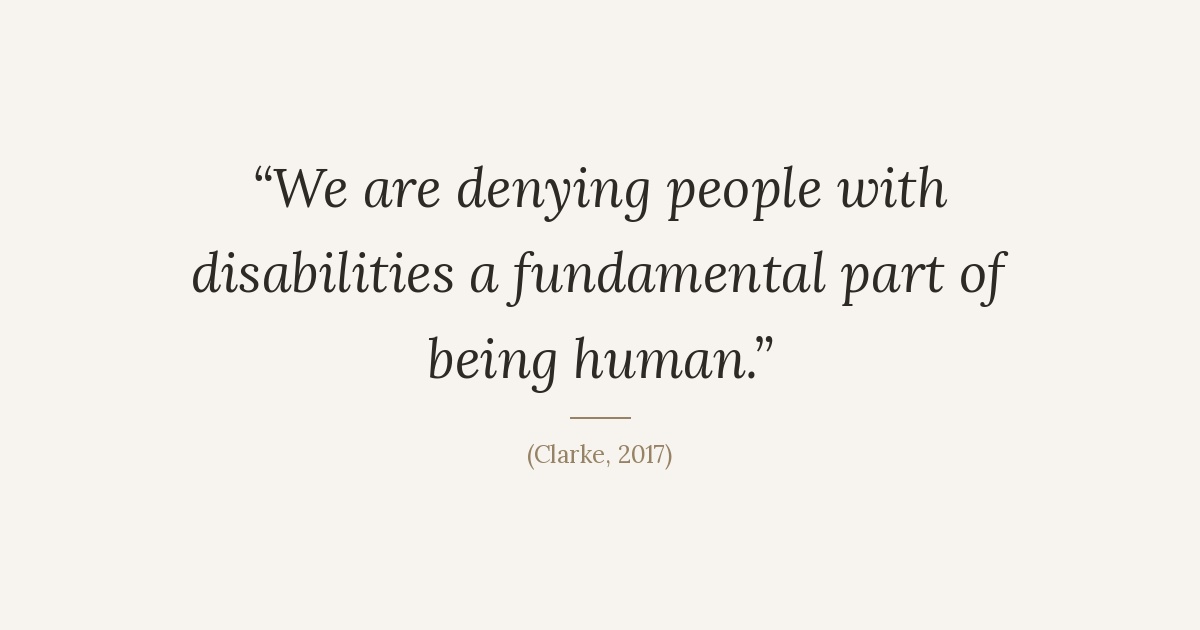
    Of course, these are only the cases reported to the CDC. There’s also the question of why any of this is happening in the first place. Some of it comes down to simple teenage disregard for safety. But the societal disregard of sexuality in the disabled community, and the resulting lack of education, has to be taken into account. Accommodations such as ASL interpreters, alternative formatting, simplified language, and physical accommodations can address most of these barriers. In other words, barriers shouldn’t be used as an excuse to avoid proper education; they should be seen as a call for proper accommodations (Clarke, 2017).

    People with intellectual and developmental disabilities (IDDs), a category of cognitive disabilities, have increasingly influenced research on the connections between sexuality, gender identity, and disability. However, this influence has not reduced the level of layered discrimination, sexual abuse, and exploitation that can lead to mental health issues. Research from the Human Rights Campaign (HRC) has also shown that 36% of LGBTQ+ adults, and 52% of transgender adults specifically, also identify as disabled, with cognitive disabilities being the most common category of disability. Unfortunately, much of the research concerning disabled LGBTQ+ people focuses solely on the perspectives of caretakers and medical professionals. Fortunately, there’s a growing push to prioritize the anonymity of those with disabilities and to increase community-engaged research (CER) (Kammes, n.d.).

    In general, disabled people tend to have lower levels of education and employment, largely because of inadequate support and teaching. Sex education is often lacking for disabled students, and special education needs are often evaluated late or inadequately supported. Those who leave school early because of disability often struggle to find employment and the benefits that come with it. Students also often lack education on LGBTQ+ issues, and around a fifth of LGBTQ+ students are outed and/or harassed. However, most of these cases go unreported because they’re seen as “not serious enough”, a pattern that can lead students to believe that reporting won’t change anything (Green et al., 2023).

    To add to this, disabled LGBTQ+ students often miss out on education because of compounded fear: being harassed, assaulted, or expelled, with their disability making it harder for them to do anything about it. Compared to those without disabilities, disabled LGBTQ+ women are also significantly less likely to find full-time work and more likely to be unable to complete the work they do find. Disabled transgender adults are also more likely to be unemployed, let go from a job, experience employment discrimination, and fear discrimination if they quit. In fact, surveys have shown that gender identity was the most common reason given for being denied promotion, fired, or not hired in the first place. Annual household income was also found to be significantly higher in homes without disabilities than in those with one or more disability (Green et al., 2023).

    References

    Clarke, T. (2017). Disability Rights and Sexual Health. AMCHP. https://amchp.org/2017/12/15/disability-rights-and-sexual-health/

    Green, A.K., Gomes, R.S.M., Heinze, N., Kempapidis, T. (2023). Queer and Disabled: Exploring the experiences of people who identify as LGBT and live with disabilities. MDPI.com. https://www.mdpi.com/2673-7272/4/1/4

    Kammes, R. (n.d.). Belonging and Community: Trends in issues relating to sexuality and gender identity for people with disabilities. Institute on Community Integration, University of Minnesota. https://publications.ici.umn.edu/impact/36-2/belonging-and-community